
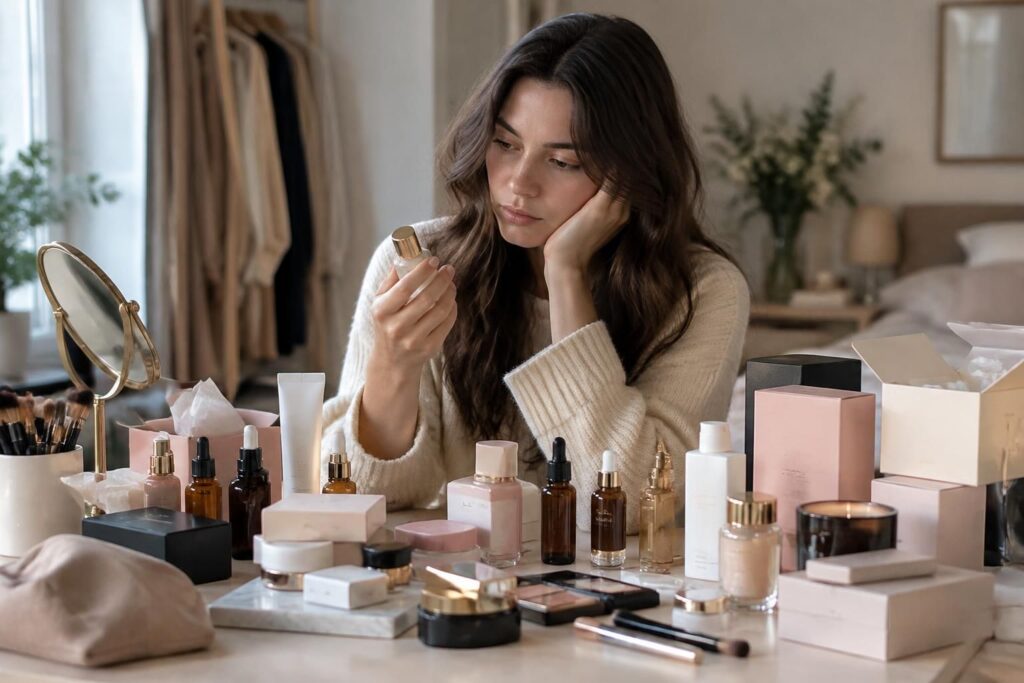
Hi, it’s Patrick. To curb beauty overconsumption, keep your routine short, wait 48 hours before making an unplanned purchase, and finish the products you’ve already opened. Beauty trends often promise quick results, but every new product can also encourage impulse buying. With social media and cosmetics marketing, it’s hard to tell a real need from a manufactured desire. The good news: a few simple steps are all it takes to take back control, without giving up the pleasure of taking care of yourself.
Do this right away
- Count the products you’ve already opened before buying another one.
- Remove any purchase from your cart if you decided to make it after watching a video or seeing a promotion.
- Wait two days before ordering a product you hadn’t planned to buy.
- Keep your beauty routine simple: cleansing, moisturizing, and sun protection if it works for you.
- Check the ingredients and intended use before believing a “miracle” claim.
To spot the pitfalls of a new product, check out these tips before following a beauty trend and these ways to shop more mindfully.
Beauty trends: why they drive up spending
A multi-step routine can make it feel as though you’re always missing a product: toner, serum, cream, mask, and then the latest product of the month. Beauty influencers make these steps visible and desirable, while viral products sometimes spread faster than information about how useful they are.
The mechanism is simple: you see a before-and-after, worry you’re missing out, and then buy before comparing. It’s social pressure in shopping-cart form. A trend isn’t necessarily useless, but its popularity doesn’t prove that it meets your needs.
Brands and platforms also know how to turn urgency into a selling point: limited editions, codes valid for a few hours, and complete routines to buy all at once. This fast beauty can fill up your bathroom and eat into your budget without improving results. Before adding a step, ask yourself what it actually does for you.
Layering and cosmetics: what the 2026 study shows
Layering, a practice popularized in Asia, involves applying several skincare products one after another. It isn’t automatically dangerous, but using more products can increase exposure to certain substances and make it harder to identify a product that causes irritation.
According to the information provided about a study published by Inserm on April 22, 2026, around a hundred female students reduced some of their cosmetic product use for five days. Urine tests showed a decrease in several exposure markers: around 22% for certain phthalates, 30% for methylparaben, and 39% for bisphenol A. These figures describe the results of this study, not an individual promise or a medical diagnosis.
The main practical takeaway is this: reducing the use of certain products can quickly lower measured exposure to some substances. That doesn’t mean you need to throw away all your skincare products. If you’re pregnant, have a skin condition, or are unsure about an ingredient, ask a healthcare professional for advice rather than following an alarming list on social media.
How to keep up with trends without automatically filling your cart
A pared-down routine can also help you avoid buying duplicates. For example, buying a serum because it’s gone viral when you already have a similar product open often leads to a buildup of half-used bottles. Responsible consumption starts with what you already have at home.
If you want to better understand the issues around this exposure, also read this article about cosmetics and traces of substances in the body. Information helps you make measured choices, not turn every ingredient into a threat.
| Situation | Helpful response | Why |
|---|---|---|
| A product goes viral | Wait 48 hours and read several detailed reviews | You reduce purchases driven by urgency and the bandwagon effect. |
| Your routine already has several steps | Finish the products you’ve opened before adding more | You avoid duplicates and unnecessary spending. |
| A claim sounds spectacular | Check the intended use and ingredients | Cosmetics marketing is no substitute for clear information. |
| A product causes a reaction | Stop using it and ask for advice if needed | Using more products can make it harder to identify the cause. |
A three-step method to buy less, but better
Step 1: take inventory. Gather your opened skincare products and sort them by use. A moisturizer you’ve already started using matters more than a new product that’s still in its packaging.
Step 2: identify what you need. Write down the specific problem you want to address, such as tight-feeling skin or a lack of sun protection. If the product doesn’t meet any identified need, leave it at the store.
Step 3: set a shopping rule. Wait two days, compare ingredients, and check your budget. For a sale, calculate the actual price and ask yourself whether you would have bought the product without the discount.
Two quick scenarios to help avoid impulse buying
If it’s a new product you’re seeing everywhere, save it to a list and come back to it after a few days. If you’ve lost interest, it was probably the trend talking rather than a real need.
If it’s a product you regularly repurchase, make sure it works for you and that you use it up. A useful repeat purchase doesn’t have the same impact as accumulating new products you only try once.
Minimalist beauty: an answer to fast beauty
Reducing the number of steps doesn’t mean neglecting your skin. A stable routine that suits you and is easy to follow is often more practical than a succession of constantly changing trends. The right measure isn’t the number of bottles, but how useful they actually are to you.
Consumers can change their habits, while formula transparency and the regulation of substances are also the responsibility of brands and authorities. Research into cumulative exposure informs this debate, but by itself it doesn’t allow us to conclude that an everyday product presents an immediate danger.
The most convincing choice is often the simplest one: buy when you’ve run out of a product, choose a formula that suits you, and be wary of claims that create a sense of urgency. A trend deserves your trust only if it meets your needs, not if it dictates your purchases.
Frequently asked questions about beauty overconsumption
Should you stop layering?
Not necessarily. You can simplify your routine if some steps are unnecessary, if you’re accumulating products, or if your skin reacts. If the problem persists, ask a healthcare professional for advice.
Are viral products necessarily bad?
No. Their popularity proves neither their effectiveness nor their uselessness. Check how they’re used, their ingredients, and whether they suit your needs before buying.
How can you limit impulse purchases?
Delay your decision by 48 hours, turn off promotional alerts, and keep a list of the products you genuinely need. This pause helps you distinguish a passing desire from a real need.
Is a short beauty routine enough?
In many cases, a few suitable products can meet essential needs. The ideal routine varies depending on your skin, lifestyle, and, if necessary, the recommendations of a professional.
Thanks for reading; best wishes, Patrick” PS: Please leave me a comment at the bottom of the page, thanks